

First Aid in the Player Pathway – Are We Ready When Something Goes Wrong?
Hockey is a fast, physical sport. Most injuries we encounter are thankfully minor – a grazed knee, a twisted ankle or the inevitable encounter between an exposed shin and a hockey ball.
Occasionally, however, something more serious happens.
When it does, the first few minutes matter.
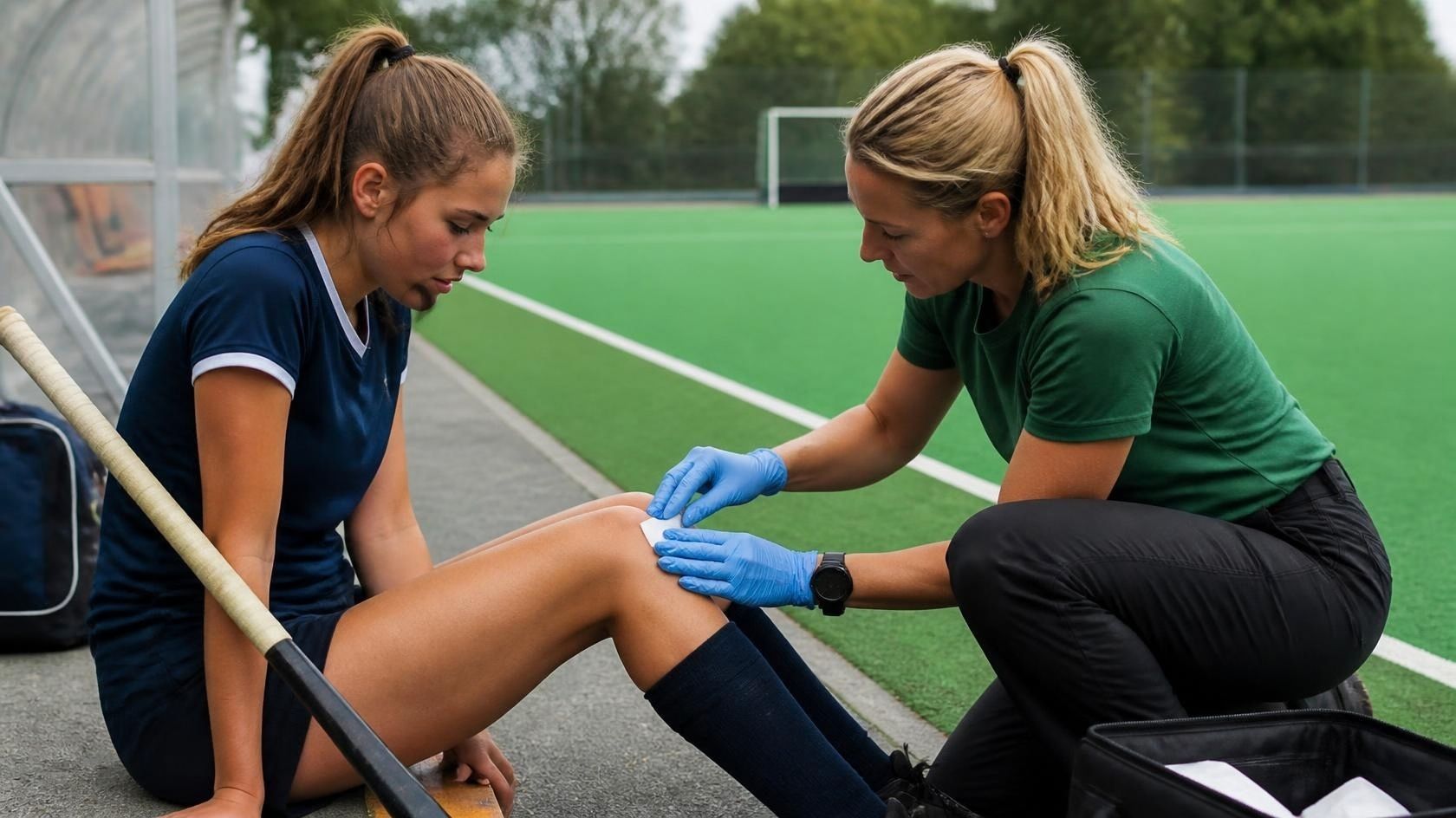
For Hampshire Hockey's Player Pathway, involving young players predominantly between 12 and 17 years old, good first-aid provision isn't simply about having a green bag somewhere beside the pitch. It means having appropriately trained people, suitable equipment and a clear plan for what happens when a player is injured.
What does England Hockey require?
England Hockey's Safe Hockey guidance recommends a minimum of one first-aid-trained individual at every match or training session.
First-aid training should be through a certified Emergency First Aid course lasting at least three hours – England Hockey's current First Aid page specifies a minimum of 3.5 hours – and must include practical CPR. Refresher or re-certification training should take place every three years.
That means qualifications such as Emergency First Aid at Work (EFAW) or First Aid at Work (FAW), where they satisfy those requirements, provide an appropriate foundation.
For Hampshire coaches, however, there is another question worth asking:
Does meeting the minimum requirement necessarily give us all the knowledge we'd ideally like beside a hockey pitch?
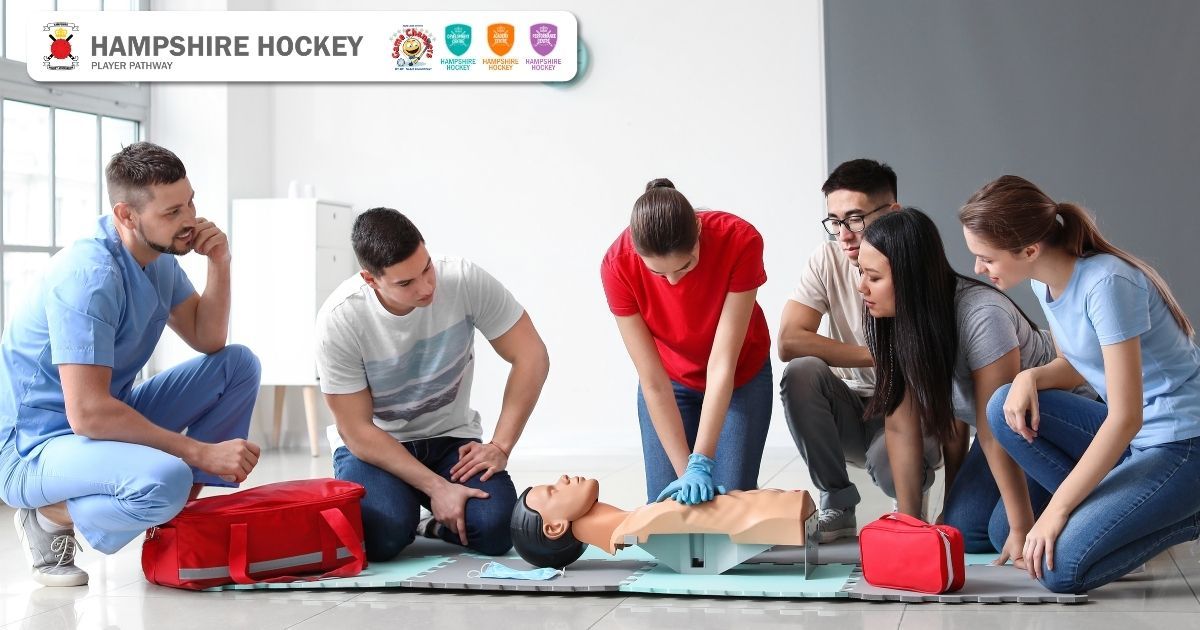
Workplace first aid and sports first aid aren't quite the same thing
A workplace first-aid course quite reasonably prepares somebody for emergencies they are likely to encounter in a workplace.
Put that same first aider beside a hockey pitch containing 20 or more teenagers armed with sticks and a very hard ball travelling at considerable speed, and the likely injuries look a little different.
As hockey coaches, the situations we might encounter include:
- concussion and significant head injuries;
- facial, mouth and dental injuries;
- fractures and dislocations;
- sprains and soft-tissue injuries;
- serious bleeding;
- asthma and breathing difficulties;
- heat or cold-related illness;
- sudden cardiac arrest; and
- deciding when a player absolutely must not return to the pitch.
That doesn't make a workplace first-aid qualification inadequate. It simply means that additional sports-specific knowledge can make an already qualified first aider better prepared for the environment in which we actually coach.
Concussion deserves particular attention
A player doesn't need to be knocked unconscious to have suffered a concussion.
England Hockey has specific concussion guidance and requires suspected or confirmed concussion and other significant head injuries occurring during hockey activity to be reported.
Coaches should therefore understand how to recognise a possible concussion, what immediate action to take and, equally importantly, why the decision about returning to hockey cannot simply be based upon a player saying, “I'm fine.”
When in doubt, player welfare comes first.
Can coaches add sports-specific training online?
yes – and this can be a very useful addition to an existing first-aid qualification.
A number of training organisations provide online Sports First Aid CPD covering subjects such as concussion, fractures and dislocations, soft-tissue injuries, wound management and pitch-side emergency assessment.
There is an important distinction, however.
Online sports training should be regarded as additional learning, not as a substitute for Hampshire's core practical first-aid qualification.
England Hockey's first-aid standard specifically includes practical CPR, so an entirely online course cannot by itself satisfy that element.
For a coach who already holds a valid FAW or EFAW qualification, though, completing additional sports-focused CPD can be an excellent way of bridging the gap between general workplace first aid and the situations we're more likely to encounter in hockey.
England Hockey also recommends a free online Sudden Cardiac Arrest course produced by UK Coaching in collaboration with Resuscitation Council UK, St John Ambulance and the Joe Humphries Memorial Trust. It takes approximately 30 minutes and can be completed regardless of previous medical experience.
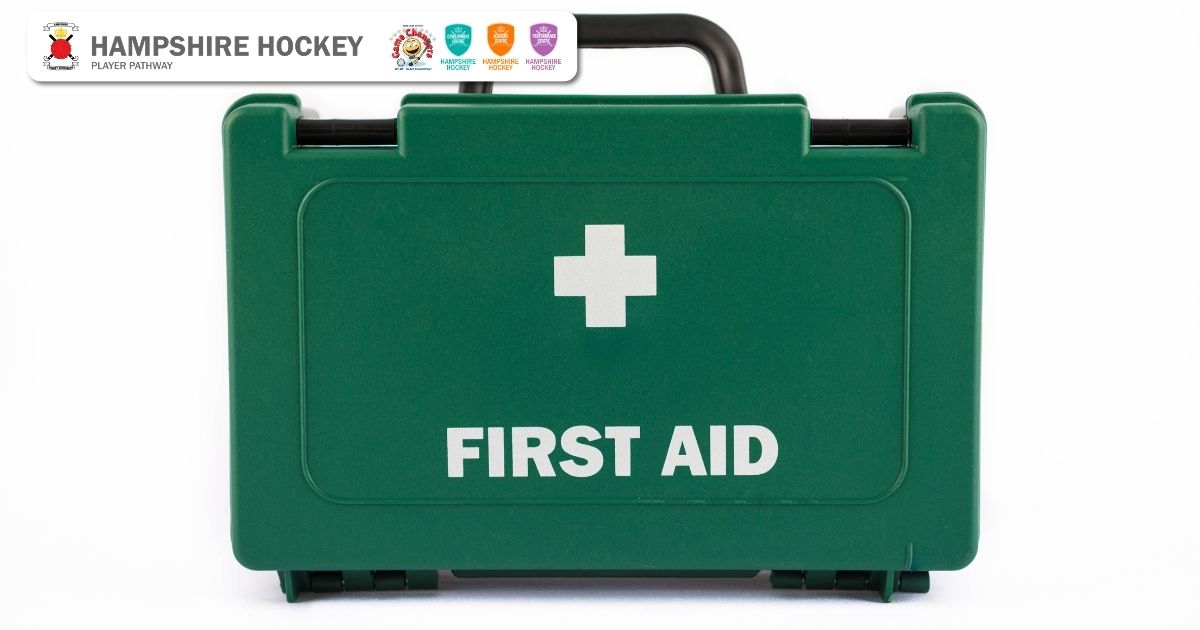
What's in an England Hockey-compliant pitch-side first-aid kit?
England Hockey does not publish a single mandatory contents list that every hockey first-aid bag must contain.
Instead, organisations are required to assess their own first-aid needs according to the activity, players, location and facilities available.
England Hockey has worked with its official supplier to produce a hockey-specific first-aid kit, but simply owning a particular branded bag isn't what makes first-aid provision appropriate.
For Player Pathway hockey, a sensible pitch-side kit should be selected following the risk assessment and should enable a trained first aider to deal with the sorts of injuries reasonably foreseeable in hockey.
That would normally mean considering provision for:
Wounds and bleeding
- sterile wound dressings in several sizes;
- sterile gauze;
- adhesive dressings/plasters;
- adhesive tape;
- non-adherent dressings;
- disposable gloves; and
- cleansing materials appropriate for first-aid use.
Sprains, strains and limb injuries
- triangular bandages;
- conforming or support bandages;
- instant cold packs; and
- appropriate materials for supporting an injured limb while awaiting further medical assistance.
Eye and facial injuries
- sterile eye dressings;
- sterile saline or appropriate eye-wash provision; and
- suitable dressings for facial wounds.
General emergency equipment
- resuscitation face shield or pocket mask;
- foil emergency blanket;
- trauma shears;
- disposable gloves;
- clinical waste bags; and
- basic first-aid guidance.
And, importantly, coaches should know where the nearest AED/defibrillator is located and how it can be accessed.
A beautifully stocked first-aid bag isn't terribly useful if nobody knows where it is, half its contents expired three years ago, or the person opening it has no idea how to use them.
The first-aid bag is only part of the plan
Before a Hampshire session begins, the coaching team should know:
- who the designated first aider is;
- where the first-aid kit is;
- where the nearest AED is;
- how emergency services can access the pitch;
- the address or location information needed when calling 999;
- how parents or guardians will be contacted;
- where players' relevant medical information can be accessed; and
- how an incident will subsequently be recorded and reported.
England Hockey places responsibility on the organisation to ensure that appropriate procedures, risk assessment and current first-aid cover are in place before activity begins.
When should an injury be reported?
England Hockey requires injuries sustained during hockey activity to be reported where a player receives treatment from a first-aid specialist or first responder, requires hospital treatment, subsequently visits a GP, or suffers a suspected or confirmed concussion or other significant head injury.
Where the injured player is under 18, their parent or guardian must also be informed.
If there is doubt over whether an incident meets the reporting threshold, England Hockey's advice is straightforward: report it.
Beyond simply ticking the First Aid box
For Hampshire, this isn't about adding another certificate to a coach's profile simply because somebody says we need one.
It's about being prepared.
Our coaches work with hundreds of young players every year. Serious incidents are rare, but when one happens we want the person standing beside that pitch to have the confidence to recognise it, take appropriate immediate action and know when the safest decision is to stop the player taking any further part.
A current first-aid qualification gives us the foundation.
Understanding the particular injuries and emergencies associated with youth hockey makes that foundation considerably stronger.
And that's the standard we should be aiming for!
What are we changing in Hampshire this year?
Writing this article has also prompted us to look again at our own procedures. We already require appropriate first-aid provision within the Player Pathway, but there are several areas where we think we can make things better, clearer and more consistent.
During the 2026/27 season we will be looking at introducing the following:
- Improved coach records within our management system. We already record coaches' first-aid qualifications and expiry dates. We plan to expand this to include additional sports-specific first-aid CPD, including concussion awareness and sudden cardiac arrest training. This will allow us to distinguish between simply holding the required qualification and coaches who have undertaken additional training particularly relevant to youth sport.
- Venue-specific emergency and risk information. We will work with each of the venues used by the Player Pathway to produce a simple risk assessment and emergency information sheet covering both the venue and the hockey activities we conduct there. This will include the precise location of the nearest defibrillator/AED, how it is accessed, first-aid facilities, emergency vehicle access, the venue address and any particular hazards coaches need to know about.
- A simple pre-session emergency check. We want Lead Coaches to know, before players start training, who is providing first-aid cover, where the first-aid kit is and where the nearest AED is located. It shouldn't take more than a minute, but those aren't things anyone wants to be discovering for the first time during an emergency.
- Clearer injury and incident reporting. We will review how significant injuries are reported within the Player Pathway so that there is a straightforward process for coaches to record what happened, what treatment was provided and whether further medical attention was required. This will also help us identify recurring risks and learn from incidents across all of our centres rather than treating each one in isolation.
- More sports-specific learning for our coaches. Where coaches already hold an appropriate first-aid qualification, we will investigate accessible additional training covering the situations they are more likely to encounter beside a hockey pitch – particularly concussion and head injury, sudden cardiac arrest and common sporting injuries.
None of this needs to become another mountain of administration for volunteer and contracted coaches. In fact, the aim is precisely the opposite.
We want the important information to be prepared centrally, easy to find and consistent at every Hampshire venue, so that our coaches can concentrate on coaching – while knowing that, on the rare occasion something does go seriously wrong, we have already thought about what happens next.
Hopefully, most of this preparation will spend the season gathering dust. We'd consider that a very successful outcome.




 by
by